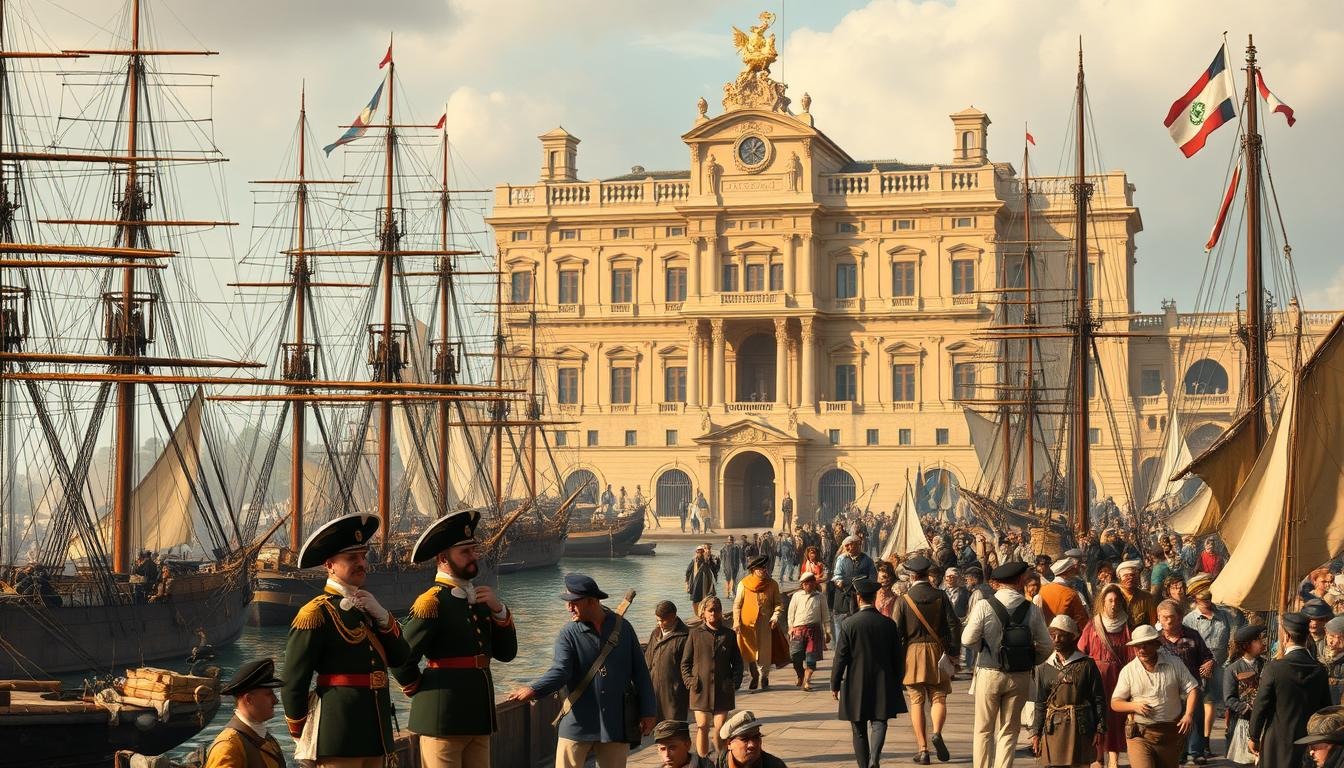
You’re about to start a journey through the history of the British Empire. This empire once covered the globe, leaving a lasting impact.
Complete History of The British Empire A Beginning To Now Production 4k document
The British Empire was the largest empire in history. It spanned a quarter of the world’s land, with diverse cultures and territories. The 4K documentary, “A Beginning To Now,” will guide you through its key events and legacy.
This documentary offers a detailed and stunning look at history. It’s perfect for history enthusiasts. You’ll learn about the empire’s rise and fall in depth.
Key Takeaways
- Explore the vast territories that once comprised the British Empire.
- Understand the significant events that shaped the empire’s history.
- Discover the legacy left behind by the British Empire.
- Experience a visually stunning account through the 4K documentary.
- Gain a deeper understanding of the empire’s rise and fall.
- Complete History of The British
The Origins of British Imperial Ambitions
The roots of British imperial dreams go back to the Tudor era. This time was filled with exploration and the start of colonies. It was the start of the British Empire’s journey around the world.
Tudor Explorations and Early Colonial Ventures
In the Tudor era, British explorers set out to the New World. They wanted to find trade paths and start colonies. Sir Francis Drake was key, challenging Spanish power and leading to British naval dominance.
Sir Francis Drake and the Spanish Rivalry
Sir Francis Drake’s journey around the world made him famous. It also challenged Spanish sea control. His actions started the rivalry between Britain and Spain, leading to future battles.
Early Settlements in the New World
The first British settlements in North America, like Roanoke and Jamestown, began the colonization. These early places faced many problems but set the stage for more growth.
British Empire Colonization
The Formation of Trading Companies
The creation of trading companies was a key moment for the British Empire. These groups helped with trade and allowed the British to spread globally.
The East India Company’s Founding
The East India Company, started in 1600, was vital for British trade in Asia. It greatly increased British influence in the area.
The Royal African Company and Early Trade Networks
The Royal African Company, founded in 1672, was involved in the slave trade. It helped build early trade links in West Africa. Its work had a big effect on the British economy.
| Company | Year Founded | Primary Region |
| East India Company | 1600 | Asia |
| Royal African Company | 1672 | West Africa |
The First British Empire Complete History of The British: 1583-1783
The First British Empire, from 1583 to 1783, set the stage for British dominance. It expanded into North America and the Caribbean. This expansion laid the groundwork for the empire’s complex dynamics later on.
North American Colonies and the 13 Colonies
The establishment of colonies along the eastern seaboard of North America was key. Jamestown, founded in 1607, was the first successful English settlement. It paved the way for more colonies.
Jamestown and the Growth of Colonial America
Jamestown’s success led to more colonies, forming the 13 Colonies. The growth of these colonies was fueled by agriculture, trade, and immigration.
Economic Relationships with the Motherland
The economic ties between the colonies and Britain were complex. The colonies provided raw materials, while Britain supplied manufactured goods. This mercantilist system aimed to strengthen Britain’s economy. But it also created tensions leading to the colonies’ desire for independence.
| Colony | Year Founded | Primary Economic Activity |
| Jamestown (Virginia) | 1607 | Tobacco |
| Massachusetts Bay | 1629 | Trade and Commerce |
| Pennsylvania | 1682 | Agriculture |
Caribbean Sugar Islands and the Slave Trade
The Caribbean colonies, like Barbados and Jamaica, were prized for sugar production. The labor force behind this was enslaved Africans, brought through the transatlantic slave trade.
Barbados and Jamaica as Crown Jewels
Barbados and Jamaica were seen as “crown jewels” due to their economic output. The wealth from sugar production greatly benefited the British economy.
The Triangle Trade and Human Cost
The Triangle Trade, involving goods and enslaved people, had a huge human cost. The transatlantic slave trade enslaved millions of Africans, causing immense harm to individuals, communities, and societies.
british empire colonization
The Loss of America and Imperial Recalibration
When the American Revolution ended, the British Empire had to rethink its role worldwide. Losing the American colonies was a big hit to its pride and economy.
The American Revolution’s Impact
The American Revolution shook the British Empire, making it question its rule and colonial policies. It showed the need for better governance and the risks of too much power.
Causes and Consequences of Colonial Rebellion
The rebellion was sparked by taxation without representation and limits on trade. It led to a new nation and changed the world’s power balance.
Lessons Learned in Colonial Management
The British took away important lessons from the American Revolution. They learned about the value of listening to locals and finding a balance between control and freedom. These lessons guided their future policies.
Shifting Focus to Asia and the Pacific
After losing America, the British Empire turned its attention to Asia and the Pacific. They looked for new places to grow and find resources. This marked a new chapter in British history.
Australia as a Penal Colony
In 1788, Australia became a penal colony. It helped solve the problem of too many prisoners in British jails. It also helped the British expand their influence in the Pacific.Complete History of The British
Strategic Interests in the East
The British also focused on the East, like India. They wanted to strengthen their power and challenge other European powers. This was the start of British dominance in the area.
The Second British Empire: 1783-1815 Complete History of The British
The Second British Empire started as a response to the Napoleonic Wars. It was a key time in the British Empire’s history. The British grew their territories through naval wins and new lands.
The Napoleonic Wars and Global Expansion
The Napoleonic Wars were tough but also opened doors for the British Empire. The British Navy was key in winning battles and spreading British power worldwide.Complete History of The British
Naval Victories and Colonial Acquisitions
British ships won many key battles, like taking the Cape Colony. This place was crucial for trade and defense. Getting these lands helped the British Empire territories grow.
The Cape Colony and Strategic Outposts
The British took the Cape Colony from the Dutch in 1806. It was a key spot for the Indian Ocean. They also set up other places to protect their interests and help trade.
Consolidation of Power in India
Getting stronger in India was a big win for the Second British Empire. The East India Company grew its power through talks and battles.Complete History of The British
The East India Company’s Territorial Control
The East India Company’s hold on India grew a lot during this time. This was the start of British rule in the area. It was a big part of British Empire achievements.
Robert Clive and the Battle of Plassey
Robert Clive won the Battle of Plassey in 1757. This was a big moment for British India, starting their rule. This battle was key in British Empire colonization.
| Year | Event | Significance |
| 1806 | Acquisition of the Cape Colony | Control of access to the Indian Ocean |
| 1757 | Battle of Plassey | Beginning of British political control in India |
The Victorian Era: Peak of Imperial Power
The Victorian era was the peak of British power. It was a time of great growth and influence. The British Empire expanded its territories and left a lasting mark on the world.Complete History of The British
The Scramble for Africa
The Scramble for Africa was a time of intense expansion. European powers, with the British leading, divided Africa into territories. This was done without considering ethnic or linguistic boundaries.
Cecil Rhodes and Southern Africa
Cecil Rhodes was key in British expansion in Southern Africa. His efforts led to the British South Africa Company. This company controlled large areas in Zambia and Zimbabwe.
The Berlin Conference and Colonial Borders
The Berlin Conference of 1884-1885 was a major event. European powers met to set rules for Africa’s division. The British gained control over vast areas as a result.Complete History of The British
| Year | Event | Impact |
| 1884-1885 | Berlin Conference | Partitioning of Africa among European powers |
| 1890s | Cecil Rhodes’ expansion in Southern Africa | Establishment of British dominance in the region |
| 1900s | Consolidation of British territories | Peak of British imperial power |
Queen Victoria as Empress of India
Queen Victoria’s title as Empress of India showed British dominance. The British Raj, established in 1858, had a big impact on India. It changed the country’s politics, economy, and culture.Complete History of The British
The British Raj and Direct Rule
The British Raj started in 1858 after the Indian Rebellion. It brought modernization to India, including railways and telegraphs.Complete History of The British
The Great Exhibition and Imperial Pride
The Great Exhibition of 1851 showcased British achievements. It celebrated British innovation and technological advancements. This reinforced British superiority.
Technological and Industrial Advantages
The British Empire’s technology and industry were key to its growth. Innovations like railways and telegraphs helped control vast territories. They maintained British dominance.
Railways and the Telegraph
Railways and telegraphs changed communication and travel in the British Empire. They helped control territories, facilitate trade, and maintain dominance.
Military Innovations and the Maxim Gun
The Maxim gun was a major military innovation. It gave the British an edge in conflicts. Its ability to fire quickly and accurately solidified British power.
The Complete History of The British Empire: A Beginning To Now Production 4K Documentary Perspective
Exploring the British Empire’s history shows how naval power was key. The Pax Britannica era was marked by global stability. This was thanks to the British Navy’s strength.Complete History of The British
Naval Supremacy and the Pax Britannica
The Royal Navy was the heart of British power. It acted as a global police force. This kept order and protected trade routes.Complete History of The British
The Royal Navy as Global Police Force
The Royal Navy did more than just fight. It kept the balance of power and enforced British interests. Its advanced tech and bases showed British authority.
Free Trade and Imperial Preference
British naval power helped expand trade. Britain followed a policy of free trade. Imperial preference, favoring empire trade, boosted British economy.
Administrative Systems and Colonial Governance
The British Empire’s systems for governing were key. Direct and indirect rule helped Britain control its vast lands. This ensured stability and control.Complete History of The British
Direct vs. Indirect Rule
Direct rule meant British law and administration in colonies with British settlers. Indirect rule let local leaders have some freedom, with British guidance.
The Colonial Civil Service
The Colonial Civil Service was crucial in applying British policies. It was made up of dedicated officials. They managed colonies, even in tough conditions.Complete History of The British
The table below shows the British Empire’s naval and administrative strengths:
| Aspect | Description | Impact |
| Naval Supremacy | Global police force maintaining order and protecting trade routes | Enabled British influence worldwide |
| Administrative Systems | Direct and indirect rule adapted to local contexts | Ensured stability and control across diverse territories |
| Colonial Civil Service | Dedicated officials implementing British policy | Effective governance in challenging conditions |
World Wars and the Beginning of Decline
The British Empire was at the center of both World Wars. Its vast territories and resources were used in the conflicts. This had a big impact on its future.Complete History of The British
The Empire’s Role in World War I
The British Empire was key in World War I. It used its vast resources and people to help win the war.
Colonial Troops and Resources
Troops from the empire fought on many fronts. They were in Europe, Africa, and the Middle East. The empire also gave financial help, military gear, and supplies.
The Mandate System and New Territories
After World War I, the empire grew. The League of Nations gave Britain control over old German and Ottoman lands. This increased the empire’s size.Complete History of The British
World War II and Imperial Strain
World War II was tough on the British Empire. It showed the empire’s weaknesses, like when Japan attacked in the East.
The Fall of Singapore and Eastern Defeats
The loss of Singapore in 1942 hurt the empire’s pride. It was a turning point. Other defeats in the East also weakened British control.
Economic Exhaustion and American Ascendancy
World War II left the empire broke. The United States became more powerful. This made Britain’s rule less strong.Complete History of The British
| Event | Impact on British Empire | Year |
| World War I | Significant contribution to Allied victory, expansion through mandate system | 1914-1918 |
| World War II | Strain on resources, loss of prestige, economic exhaustion | 1939-1945 |
| Fall of Singapore | Loss of British prestige, erosion of control in the East | 1942 |
Decolonization and Complete History of The British
You saw the end of a huge empire as colonies fought for freedom. The decolonization era was the last part of the British Empire. It was filled with both peaceful changes and violent fights.
Independence Movements and Peaceful Transitions
Many areas got their freedom without much violence. This led to the birth of new countries.
India and Pakistan’s Partition
The split of India and Pakistan in 1947 was a big event. It created two new nations. But it also caused a lot of trouble and people had to move.Complete History of The British
African Independence and the Wind of Change
British Prime Minister Harold Macmillan’s “Wind of Change” speech in 1960 showed a big change. It was towards freedom for African nations. Many African countries became free in the years that followed.
Violent Struggles and Forced Withdrawals
Not all fights for freedom were calm. Many areas had to fight hard to get the British to leave.
The Suez Crisis and Imperial Humiliation
The Suez Crisis in 1956 was a big blow to the British Empire. It showed the empire’s power was fading, as the US and UN stepped in.
Kenya, Malaya, and Counter-Insurgency
In Kenya and Malaya, the British faced strong opposition. They had to use force to keep control until these areas gained freedom.
Looking back, the British Empire’s legacy is mixed. It had both good and bad effects on the new countries. The end of the empire changed world politics and left a mark on how countries relate to each other.
Conclusion: The Legacy of the British Empire
You’ve looked into the vast and complex history of the British Empire. From its start to its end, it’s a story of great achievement and lasting impact. The Complete History of The British Empire | A Beginning To Now Production 4K documentary tells this story in detail.
The British Empire’s legacy still shapes today’s world in politics, economies, and cultures. Knowing this history helps us understand today’s world better. This documentary is a great way to learn about the empire’s impact.Complete History of The British
Reflecting on the British Empire’s history shows its importance in shaping our world today. The Complete History of The British Empire | A Beginning To Now Production 4K documentary is a key resource for anyone wanting to dive deep into this fascinating history.
FAQ
What is the time span covered by the documentary on the British Empire?
The documentary spans from the start to the end of the British Empire. It gives a full view of its rise and fall.
What were the key factors that led to the establishment of the British Empire?
Tudor explorations and the East India Company’s formation were key. Early ventures in North America also played a role.
How did the British Empire expand during the Victorian era?
The Victorian era saw the Empire grow a lot. It expanded into Africa, Australia, and solidified power in India. This was the peak of British power.Complete History of The British
What was the significance of the Napoleonic Wars for the British Empire?
The Napoleonic Wars helped the British win naval battles. They got new colonies and expanded their interests, mainly in the Cape Colony and India.
How did the British Empire contribute to World War I and II?
The Empire played a big role in both wars. It sent colonial troops and resources. It suffered heavy losses, mainly in the East during World War II.
What led to the decline of the British Empire?
The Empire’s decline was due to World War II’s economic strain. Independence movements and decolonization also played a part.
What is the legacy of the British Empire?
The Empire’s legacy is complex. It has shaped global politics, economies, and cultures. It still influences international relations and the modern world.Complete History of The British
Is the documentary available in 4K resolution?
Yes, the documentary is in 4K resolution. It offers a stunning and detailed look at the Empire’s history.
What territories were part of the British Empire?
The Empire covered vast areas. It included North America, the Caribbean, Africa, Asia, and the Pacific. This included the 13 colonies, India, Australia, and more.Complete History of The British
How did the British Empire manage its vast territories?
The Empire used direct and indirect rule. It employed the Colonial Civil Service and other systems to govern its colonies.