You’re about to start a journey through History of The United States of America It spans from its first people to its role as a global leader today. America’s story is both complex and varied.
The United States of America | A Beginning To Now Production
This journey will show you the major events, people, and cultural changes that shaped the nation. You’ll see the ups and downs of American history. It covers from the early days to now.History of The United States
Key Takeaways
- Understand the foundational events that shaped the United States.
- Explore the major historical periods and their significance.
- Learn about the key figures who influenced History of The United States.
- Discover the cultural and social changes that have impacted the nation.
- Gain insights into the complexities of American identity.
Understanding the Pre-Colonial Foundations
Exploring America’s roots reveals a world of indigenous cultures before European settlers arrived. The pre-colonial era was a key time in united states history. It was filled with many Native American civilizations.History of The United States
Identifying Major Indigenous Nations and Their Territories
The Native American populations were varied, with different nations and lands across the continent. Two main areas were the Eastern Woodland and the Plains and Southwestern regions.History of The United States
Eastern Woodland Civilizations
The Eastern Woodland was home to tribes like the Iroquois and Algonquin. They built complex societies with advanced farming skills.
Plains and Southwestern Cultures
On the other hand, the Plains and Southwestern regions had nomadic tribes like the Sioux and Apache. There were also settled civilizations, such as the Pueblo peoples.
A serene landscape of a pre-colonial Native American village nestled in a lush, verdant forest. In the foreground, a group of indigenous people engage in traditional activities such as weaving, pottery making, and storytelling around a central fire pit. The middle ground features a collection of intricate wooden structures and tipis, their designs reflecting the unique cultural heritage of the tribe. In the background, majestic mountains rise, their snow-capped peaks glowing in the warm, golden light of the setting sun, casting a peaceful, ethereal glow over the scene. The atmosphere is one of tranquility, harmony, and a deep connection to the land and its natural rhythms.History of The United States
Recognizing Native American Contributions to American Identity
Native American cultures have greatly shaped american heritage. They’ve influenced food, language, and more.
Tracing Early European Exploration
The arrival of European explorers brought big changes for Native Americans. Knowing about these early interactions helps us understand usa history better.History of The United States
Exploring European Colonization (1492-1763)
Between 1492 and 1763, European nations set up colonies in the Americas. Each had its own special features. You will learn how different ways of colonizing shaped the early history of the United States.
Comparing Spanish, French, and British Colonial Models
The Spanish, French, and British had different ways of colonizing. Spanish colonization was about conquering and converting native people. French colonization focused on trade and spreading Christianity. On the other hand, British colonization was driven by economic, religious, and territorial goals.
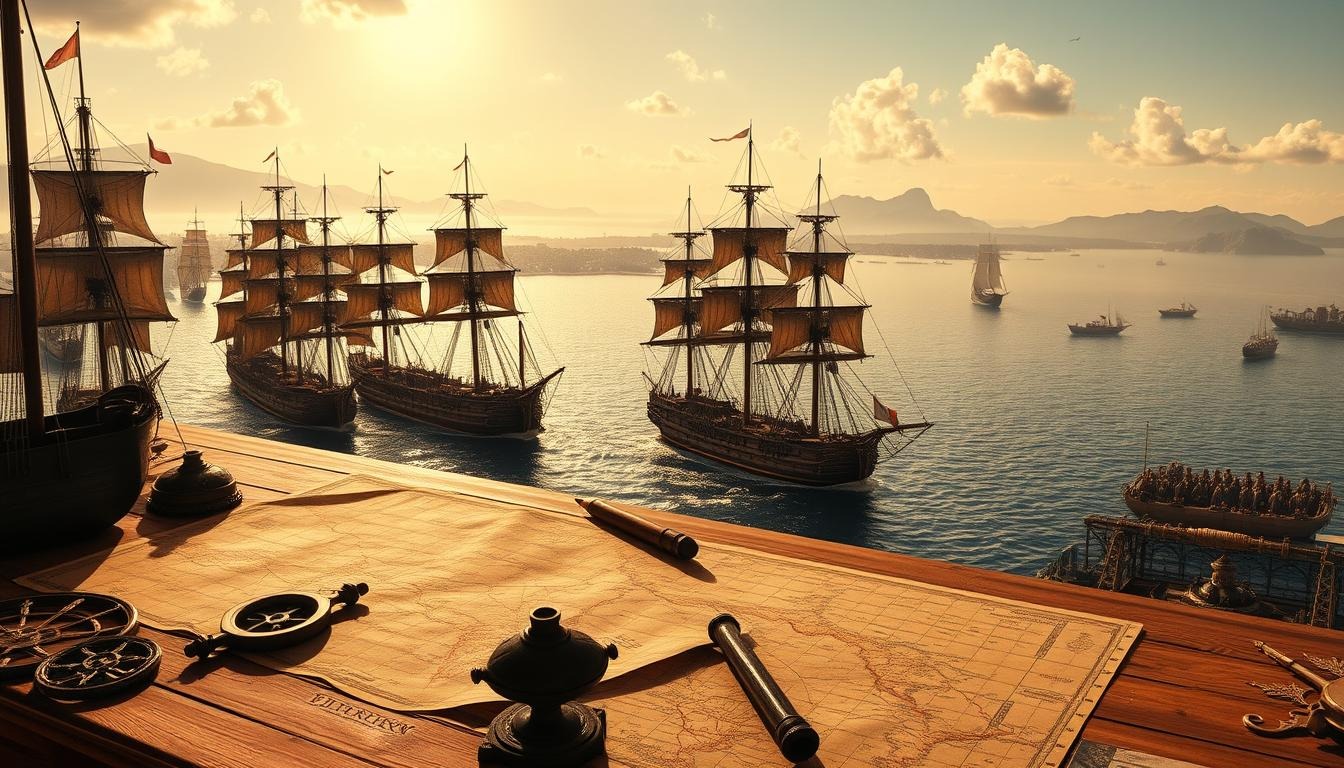
A grand European colonial armada of ornate ships and galleons, majestic and imposing, sailing across a vast, sun-dappled ocean. In the foreground, intricate maps and navigational instruments lie scattered on a wooden table, hinting at the exploratory ambitions of the era. The background features a panoramic vista of distant shorelines, lush forests, and towering mountains – the promise of untamed lands ripe for conquest and settlement. Warm, golden lighting illuminates the scene, evoking a sense of grandeur and historic significance. The overall composition conveys the scale, ambition, and transformative impact of European colonization during this pivotal period in world history.History of The United States
Examining the Thirteen British Colonies
The thirteen British colonies were very different. They ranged from the New England colonies in the north to the Southern colonies. Let’s take a closer look at these colonies.
New England Colonies
The New England colonies, like Massachusetts and Connecticut, were mainly for religious reasons.
Middle Colonies
The Middle colonies, including Pennsylvania and New York, had diverse populations and economic activities.History of The United States
Southern Colonies
The Southern colonies, like Virginia and Georgia, were mostly focused on agriculture, with big plantations.
| Colony Type | Primary Characteristics | Examples |
| New England | Religious, small farms | Massachusetts, Connecticut |
| Middle | Diverse, trade-oriented | Pennsylvania, New York |
| Southern | Agricultural, plantations | Virginia, Georgia |
Analyzing Colonial Society and Economy
Colonial society was complex, with interactions between European settlers, Native Americans, and Africans. The economy was mainly based on farming, with trade also important. Understanding these aspects is key to understanding American history and the American timeline.History of The United States
Tracing the Path to Independence (1763-1776)
Between 1763 and 1776, the American colonies went through a big change. This was due to growing problems with Britain and new ideas about freedom. This time was key in shaping the United States’ future.History of The United States
Identifying Key Causes of Colonial Discontent
Taxes like the Stamp Act and Townshend Acts without consent caused a lot of anger. Resistance to British rule grew. People started to doubt the British Parliament’s control over them.History of The United States
Following the Development of Revolutionary Thought
As tensions rose, new ideas about freedom started to spread. Thinkers like Thomas Paine and John Locke encouraged people to challenge British rule. They believed in self-governance and that government gets power from the people.History of The United States
Analyzing the Declaration of Independence
The Declaration of Independence was adopted on July 4, 1776. It marked the colonies’ split from Great Britain. Key principles included the right to life, liberty, and the pursuit of happiness.
Key Principles and Authors
Thomas Jefferson mainly wrote the document. It reflected Enlightenment ideas. The Declaration’s clear statement of democratic values has made it a key part of US history.History of The United States
Global Impact and Legacy
The Declaration of Independence shaped American history and inspired freedom movements worldwide. Its impact on politics and action is seen today. It’s a critical part of the USA‘s story.History of The United States
Navigating the American Revolution (1775-1783)
The American Revolution was a key moment in American history. It lasted from 1775 to 1783. This time saw many battles, important leaders, and talks with other countries.History of The United States
Mapping Critical Battles and Turning Points
The war had many battles that changed its course. Lexington and Concord started it all. Then, Saratoga convinced France to help the Americans.
Other big fights were Bunker Hill, Long Island, and Yorktown. At Yorktown, British General Cornwallis gave up, ending the war.
Studying Revolutionary Leaders and Their Strategies
Leaders were key in the war’s outcome. George Washington led the Continental Army well. Benjamin Franklin got France to support the Americans.History of The United States
Other leaders like Nathaniel Greene and Henry Knox helped a lot. They used smart tactics and organized well.
Understanding International Dimensions of the Conflict
The war wasn’t just a fight at home. It involved other countries too. France helped the Americans a lot. They gave money, troops, and advice.History of The United States
Other countries like Spain and the Netherlands also fought against Britain. They didn’t want Britain to be too powerful.
Examining the Peace Process and Treaty of Paris
The Treaty of Paris ended the war in 1783. It made America an independent country. It also set the country’s borders.
The treaty was signed by Benjamin Franklin, John Adams, and John Jay. It was a big win for America. It made Britain recognize America’s freedom.
- The Treaty of Paris was signed on September 3, 1783.
- It recognized the independence of the United States.
- The treaty established the boundaries of the new nation.
In conclusion, the American Revolution was complex. It involved battles, leadership, and talks with other countries. Learning about this time helps us understand America’s history and values.History of The United States
Constructing a New Government (1783-1800)
The Treaty of Paris in 1783 made the United States an independent nation. But, creating a stable government was the real challenge. This period in American history was key to shaping the country’s future.
The Articles of Confederation
The Articles of Confederation were adopted in 1781 as the first attempt at a unified government. But, it failed because it gave too much power to the states. This made the central government weak, unable to enforce laws or control commerce.History of The United States
The Constitutional Convention Debates
The Constitutional Convention in 1787 was a response to these problems. Influential figures like George Washington, James Madison, and Benjamin Franklin debated the new government’s structure and powers. Their work resulted in the United States Constitution, a document that has stood the test of time.History of The United States
The Federalist Papers and Ratification Process
The Federalist Papers were written by Alexander Hamilton, James Madison, and John Jay to support the Constitution. These essays, published in newspapers, addressed concerns and highlighted the benefits of a stronger federal government. They played a key role in shaping public opinion during this time.
“We the People of the United States, in Order to form a more perfect Union, establish Justice, insure domestic Tranquility, provide for the common defence, promote the general Welfare, and secure the Blessings of Liberty to ourselves and our Posterity, do ordain and establish this Constitution for the United States of America.”
Washington’s Precedent-Setting Administration
George Washington’s inauguration in 1789 started a new era. His leadership set important precedents for the executive branch. He established the cabinet system and defined the president’s role. As the first president, Washington’s decisions greatly influenced the United States, shaping its government and its role in the world.History of The United States
The construction of a new government was complex and challenging. The foundations laid between 1783 and 1800 helped the United States become a strong and lasting democracy.
Charting Territorial Expansion (1800-1860)
In the early 19th century, the United States grew a lot. This growth was due to big events like the Louisiana Purchase and the idea of Manifest Destiny.History of The United States
Following the Louisiana Purchase and Western Exploration
The Louisiana Purchase in 1803 was a big deal. The U.S. got about 828,000 square miles of land from France for $15 million. This deal doubled the U.S. and set the stage for more growth. “The Louisiana Purchase was a defining moment in American history, marking the beginning of the country’s rise as a continental power,” historians say.History of The United States
Understanding the War of 1812’s Impact on National Identity
The War of 1812 was key in shaping American identity. Fighting Britain made Americans more patriotic and united. It also changed how the U.S. treated Native American tribes, making the government’s power more clear.
Tracing Manifest Destiny and Its Consequences
Manifest Destiny was a big idea that pushed the U.S. to expand. It led to the Mexican-American War and hurt Native American tribes.
Mexican-American War
The Mexican-American War (1846-1848) gave the U.S. a lot of land. This included California, Nevada, Utah, Arizona, New Mexico, Texas, and parts of other states. The Treaty of Guadalupe Hidalgo changed the U.S. a lot.
Native American Displacement
The U.S. government’s push for expansion hurt many Native American tribes. The Trail of Tears in 1838-1839 was a brutal example of this.History of The United States
Analyzing the Growing Divide Over Slavery
As the U.S. grew, the slavery debate got worse. The fight over whether new states would allow slavery or not widened the gap between the North and South. This gap eventually led to the Civil War.
“The westward expansion of the United States was a complex and multifaceted process that had far-reaching consequences for the country’s development.”
The years from 1800 to 1860 were very important for the U.S. They saw a lot of growth and rising tensions that led to the Civil War. Knowing about this time helps us understand American history better.History of The United States
Examining the Civil War and Reconstruction (1861-1877)
The Civil War was a key moment in U.S. history. It happened from 1861 to 1865 and changed the country. It also set the stage for the Reconstruction era that followed.History of The United States
Causes of Secession
The South’s decision to leave the Union was complex. Economic, cultural, and political differences between the North and South grew over time. The election of Abraham Lincoln in 1860 was seen as a threat to slavery.History of The United States
Key Military Campaigns and Leadership
The Civil War had many important battles and decisions. Leaders like Robert E. Lee and Ulysses S. Grant were key. The Battle of Gettysburg was a turning point, helping the Union win.History of The United States
Lincoln’s Wartime Policies
Abraham Lincoln made big decisions during the war. He issued the Emancipation Proclamation and pushed for Constitutional changes.
The Emancipation Proclamation
In 1863, Lincoln freed slaves in Confederate territory. This changed the war’s goal to include ending slavery.History of The United States
Constitutional Amendments
Lincoln supported the 13th Amendment to end slavery nationwide. This was a major step towards freedom for former slaves.History of The United States
Evaluating Reconstruction’s Successes and Failures
Reconstruction aimed to rebuild the South and protect former slaves’ rights. It had successes, like the 14th and 15th Amendments. But, it also faced challenges and backlash, leading to Jim Crow laws and ongoing racial issues.
In conclusion, the Civil War and Reconstruction were critical times in U.S. history. They were marked by conflict, important laws, and the fight for equality. Understanding these periods helps us see the complexities of the U.S. past and its lasting effects today.History of The United States
The United States of America | A Beginning To Now Production: Industrial Transformation (1877-1914)
Between 1877 and 1914, America saw a big change. It moved from being mostly rural to being a country of factories and machines.History of The United States
Tracking the Rise of American Industry and Innovation
Technological innovations and infrastructure development were key in America’s growth. Railroads, for example, helped move goods across the country. This connected markets and industries in ways they never were before.History of The United States
Studying Immigration Patterns and Urban Growth
In the late 19th and early 20th centuries, many immigrants came to America. They were attracted by jobs in the growing factories. This led to fast growth in cities like New York, Chicago, and Philadelphia.
These cities became centers of culture and business. They grew in ways never seen before.
Analyzing Progressive Era Reforms
The Progressive Era lasted from the late 19th century to the early 20th century. It was a time of big changes to fix problems caused by factories. These changes were made in politics and society.History of The United States
Political Reforms
Political changes included direct election of senators and new ways for citizens to vote. These changes let people have more say in government.
Social Reforms
Social changes focused on workers’ rights, women’s voting, and health. Laws were made to protect workers, like rules about child labor and work hours. Women’s right to vote became a reality in 1920.
Understanding America’s Emergence as a Global Power
As America grew, it started to play a bigger role worldwide. The Spanish-American War in 1898 was a key moment. The U.S. got territories in the Pacific and the Caribbean, showing it was a world leader.History of The United States
Navigating America’s Rise to World Power (1914-1945)
America’s path to becoming a world leader was marked by World War I, the Roaring Twenties, the Great Depression, and World War II. These events greatly changed the nation.
Examining America’s Role in World War I
At first, the U.S. stayed out of World War I. But in 1917, it joined the fight. This move was a big step for America, making it a key player globally. The U.S. used its vast resources to support the war, creating new agencies and boosting patriotism.
“The war effort was not just about winning the war; it was about creating a new world order.” –
Woodrow Wilson
Exploring the Roaring Twenties Cultural Revolution
The 1920s saw big changes in American culture. Jazz, flappers, and consumer culture became popular. The Harlem Renaissance celebrated African American art, literature, and music. Women’s rights also made progress, with the 19th Amendment giving them the vote.
Understanding the Great Depression and New Deal Response
The Great Depression hit America hard, starting in 1929. President Franklin D. Roosevelt’s New Deal aimed to help those in need. Key programs like the Works Progress Administration and the Social Security Act helped a lot.History of The United States
| New Deal Program | Purpose |
| Works Progress Administration | Provided jobs for millions through infrastructure projects and more. |
| Social Security Act | Started a system of old-age pensions for workers. |
Analyzing World War II’s Transformation of American Society
World War II changed America a lot. The government worked hard to win the war. The war brought new tech, medical advances, and social justice.History of The United States
Home Front Mobilization
The U.S. government did a lot to get everyone involved. This included rationing, propaganda, and boosting patriotism.
Military Campaigns
American forces were key in winning the war. They fought in important battles like D-Day and the Battle of the Bulge.
Postwar Planning
As the war ended, the U.S. and its allies planned for the future. They set up the United Nations.
Decoding the Cold War Era (1945-1991)
After World War II, the United States and the Soviet Union became superpowers. This led to the Cold War. You might wonder how this period shaped American history and the world.History of The United States
Tracing the Origins of US-Soviet Tensions
The Cold War’s start was complex, with politics, economics, and beliefs playing big roles. The Yalta and Potsdam conferences were key, with disagreements over land and power. These early issues set the stage for long-lasting conflicts.
Examining American Involvement in Korea and Vietnam
The US got involved in Korea and Vietnam to stop communism. The Korean War was the first big Cold War fight. The Vietnam War was a big deal in the 1960s and 1970s. These wars changed America a lot.
Following the Civil Rights Movement’s Evolution
The Civil Rights Movement grew strong during the Cold War, led by Martin Luther King Jr.. The movement pushed for racial equality. It was influenced by the Cold War’s push for democracy abroad and equality at home.
Understanding Technological Competition and the Space Race
The Cold War saw a big tech race, with the Space Race being a highlight. The Soviet launch of Sputnik in 1957 sparked a US response. This race pushed science and technology forward.
Analyzing the End of the Cold War
The Cold War ended in the late 1980s and early 1990s. The Soviet Union collapsed, ending communism.
“The fall of the Berlin Wall in 1989 symbolized the end of the division of Europe and the decline of Soviet influence.”
This marked a new era in world relations, with the US as the top power.
Looking at the Cold War era, it was a key time for American history and the world. The tensions, conflicts, and races of that time are felt today in global relations and society.
Witnessing the Information Age (1991-2001)
In the 1990s, the United States saw big changes. The Cold War ended, bringing peace and new tech. This was a time of great progress.
Examining Post-Cold War American Foreign Policy
The U.S. became the only superpower, facing new chances and problems. Its foreign policy was both active and cautious. It got involved in the Balkans but was slow to act elsewhere.
Tracking the Digital Revolution and Economic Boom
The 1990s saw the internet grow fast, changing the economy and society. A tech boom brought wealth, with the tech industry growing a lot.
Understanding Cultural and Social Transformations
This time had big cultural shifts, thanks to tech and changes in who lived in America. New media and entertainment showed and shaped society.
Media and Entertainment
The 1990s brought new media and entertainment. Alternative rock, grunge, and new movies were big.
Demographic Changes
Changes in who lived in America also shaped culture. Migration and population changes played a big role.
The Information Age mixed tech, economy, and society in complex ways. It set the stage for the 21st century’s challenges and chances.
Navigating 21st Century America (2001-Present)
Understanding 21st-century America is key. The new millennium brought big changes and challenges. These have shaped our society and policies today.
Analyzing 9/11’s Impact on American Society and Policy
The 9/11 attacks changed America forever. They led to a new foreign policy focus, including wars in Afghanistan and Iraq. At home, the Patriot Act gave law enforcement more power, focusing on security.
Tracking Economic Challenges and Recovery
The 21st century faced big economic hurdles, like the 2008 crisis. It caused job losses and a huge bailout. The recovery efforts, led by the Federal Reserve, have shaped our economy.
Understanding Political Polarization and Its Causes
Politics in America have become more divided. The gap between Democrats and Republicans has widened. Changes in demographics, media, and gerrymandering have contributed to this.
Examining Technological and Social Media Influence
The internet and social media have changed how we communicate and engage in politics. The digital communication revolution has brought new ways to connect and mobilize. But it also raises concerns about misinformation and privacy.
Digital Communication Revolution
Smartphones and social media have changed how we get news and talk about politics. This shift affects many areas of life, from politics to personal relationships.
Social Movements in the Digital Age
Social media has helped social movements like Black Lives Matter and #MeToo grow. These movements use digital platforms to spread awareness, organize, and push for change.
Experiencing American History Today
American history is more than just a textbook subject. It’s a story that lives around us. As you explore the United States’ rich heritage, you’ll find many ways to connect with the past.
Visiting Key Historical Sites and Monuments
Visiting historical sites and monuments is a great way to connect with American history. Places like Independence Hall in Philadelphia, the Statue of Liberty in New York, and the Lincoln Memorial in Washington D.C. offer a tangible link to the past. These sites provide a unique opportunity to reflect on the events and people that shaped the nation.
Utilizing Museums and Digital Archives
Museums and digital archives are key to understanding American history. Places like the Smithsonian and the National Archives have a vast array of historical artifacts and documents. Digital platforms have made it possible to explore these resources from anywhere in the world.
Participating in Historical Preservation Efforts
You can also help preserve American history. This can involve visiting National Parks and Historic Landmarks, which show the country’s natural beauty and historical significance. Also, Community History Projects let individuals help preserve local history.
National Parks and Historic Landmarks
National Parks and Historic Landmarks are key in keeping historical sites intact. They provide a safe space for these sites, ensuring they are preserved for future generations.
Community History Projects
Community History Projects engage local communities in preserving their history. These projects often involve collecting oral histories, restoring historical buildings, and creating local museums.
Conclusion: Understanding America’s Ongoing Story
Reflecting on the United States’ history, it’s clear its story is far from over. From its early days to now, America has been shaped by many cultures and big events. The struggle for identity and unity continues.
The journey through the United States of America | A Beginning To Now Production has shown key moments. You’ve seen how America changed through the American Revolution, the Civil War, and the Civil Rights Movement. These events have woven a complex history.
Today, America keeps changing, dealing with political divides, new tech, and social shifts. Looking back helps us understand today’s America and its role globally. It’s key to grasp the past to see the present clearly.
The story of America is rich and ever-changing. It’s shaped by its people, their ideas, and the world around them. Knowing America’s history helps us see today’s issues more clearly. It encourages us to engage deeply with America’s ongoing story.
FAQ
What is the main focus of “The Complete History of The United States of America | A Beginning To Now Production”?
This documentary aims to give a full history of the United States. It covers everything from the earliest times to today.
What can I expect to learn from this historical documentary?
You’ll learn a lot about American history. It includes key events, important figures, and cultural changes that have shaped the country.
How is the history of the United States organized in this production?
The history is shown in order, starting with the pre-colonial era. It then moves through European colonization, the American Revolution, and up to today.
What topics are covered in the section on pre-colonial foundations?
This part talks about the indigenous peoples and their cultures. It also covers early European explorers and their impact on American identity.
How does the production address the American Revolution?
It looks at why the colonies were unhappy, the growth of revolutionary ideas, major battles, and the Declaration of Independence’s importance.
What aspects of the Civil War and Reconstruction are discussed?
It talks about why the South seceded, key battles, Lincoln’s actions, and what happened after the war.
How does the production cover modern American history?
It covers how America became a world leader. This includes its role in World War I and II, the Cold War, and today’s issues like 9/11 and technology.
What resources are suggested for further exploration of American history?
It suggests visiting historical sites, using museums and online archives, and helping preserve history.
Is “The Complete History of The United States of America | A Beginning To Now Production” suitable for all ages?
Yes, it’s made for everyone. It’s informative and fun for all ages and backgrounds.
Can I access additional materials or updates related to this historical documentary?
Yes, you can find more resources and updates on the production’s website or other platforms.